
Utility Infrastructure
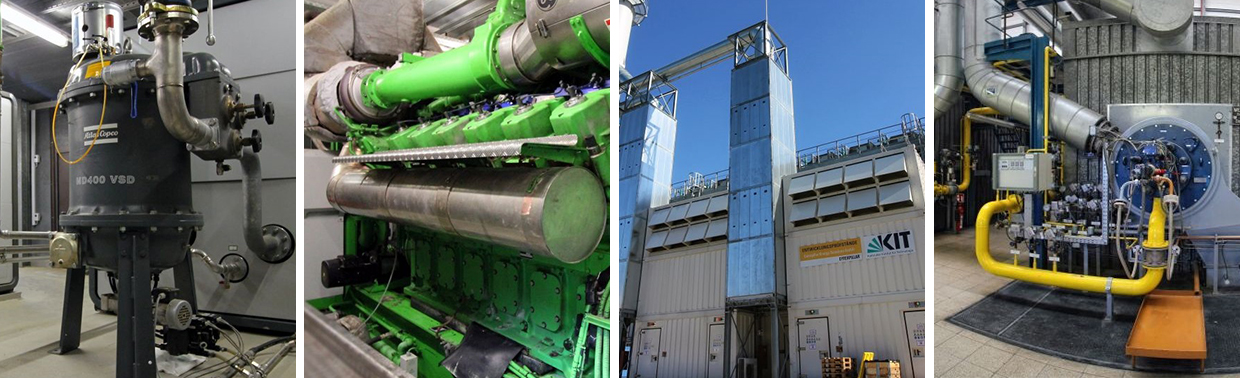
The services related to utility management (VM) at Campus North include the generation and/or distribution of electricity, district heating, drinking water, deionized water, compressed air, and gas.
Important Documents
Thermal power station
The district heating plant is supplemented by a combined heat and power (CHP) plant.
- Manufacturer: GE Jenbacher
- Operating principle: 4-stroke
- Type: Gasoline engine
- Number of cylinders: 12
- Fuel: Natural gas
- Length: ~ 7,600 mm
- Width: ~ 2,200 mm
- Height: ~ 2,800 mm
- Weight: ~ 22,400 kg
- Thermal output: 1,925 kW
- Electrical output: 1,999 kWel
- Overall efficiency: 84.7%
- This results in a total usable output of 3,924 kW
Compressed air
The compressed air supply to the research facilities and organizational units on the Campus North is distributed via a central compressed air network and regulated by a control system based on load demand. Compressed air is generated at three locations. Due to regulatory requirements, some divisions maintain an additional redundant supply. FM-VEA has three emergency compressors that can be used to provide decentralized supply in the event of a malfunction.
- Installed capacity: approx. 685 kWel
- Network pressure: 6–7 bar
- Production: approx. 15,000,000 Nm³/year
Power Supply
Electricity is supplied to the research facilities and organizational units on the Campus North grounds via a dedicated 20 kV cable network. The connection to the upstream EnBW grid is established through a 110/20 kV substation.
A dedicated control room is operated to monitor the power supply network.
In the event of a power outage, six emergency power generators ensure a reliable power supply for selected divisions. Certain specific facilities have their own emergency power generators. Part of the required electrical energy is generated on-site by four combined heat and power (CHP) units. FM has two mobile emergency power generators, which can be used to establish a decentralized power supply in the event of a failure.
- Substations:
110/20 kV: 3 transformers, Pel = 86 MVA | 20/0.4 kV: 33 transformers, Pel = 103 MVA - Emergency power systems: 6 units
- Circuit lengths:
20 kV: 21 km | 0.4 kV: 51 km - Number of service points:
20 kV: 20 | 0.4 kV: approx. 520 - Area served: approx. 2.5 km²
Note: To comply with the legal requirement to provide information on grid usage fees, you can download a summary in PDF format here.
District Cooling
In 2016, cooling station No. 1 was constructed in Building 612 as the first component of a district cooling system; it is currently connected via an initial network segment to the mainframe systems at the KIT Steinbuch Center for Computing (CN) and supplies them with chilled water. Further expansion of the district cooling network is planned.
Cooling Station No. 1 is a so-called CHP plant that operates on the principle of thermal refrigeration. Absorption refrigeration systems, when combined with a combined heat and power (CHP) plant—as is the case with Refrigeration Station No. 1—can be used to generate cooling in a highly efficient and cost-effective manner.
- Combustion heat output: 4.6 MW
- Refrigeration capacity: 1.2 MW
- Electrical output: 2 MW
- Supply temperature: 6–10°C
- Return temperature: 12–16°C
District Heating
Heat is generated at Campus North in the district heating plant and the GEL facility. A district heating network supplies hot water to approximately 285 buildings on Campus North, with a total usable floor area of over 320,000 m².
- District heating plant with 3 hot-water boilers + CHP unit, 2 MWel + tn, max. 49 MW
- Fuel: Natural gas/heating oil "EL" (boilers only)
- Total length of district heating network: approx. 17 km (one-way length)
- Temperature (inlet/outlet): Inlet max. 110°C, outlet 65°C
- Network pressure: 6 bar
Gas
For its natural gas supply, Campus North is connected to a 60-bar high-pressure pipeline in the Hardtwald.
Via a gas pressure regulation station and metering system, the heating plant—including CHP units—as well as decentralized institutions such as the laundry, EnergyLab, and six other end users are supplied with natural gas through a dedicated underground network on the plant grounds.
- Natural gas network total length: approx. 3 km
- Network pressure: 2.5 bar
- Heat content: approx. 11 kW/Nm³
Gas Engine Testing Laboratory (GEL)
The gas engine testing laboratory has been operated by VEA since 2016 as part of a research collaboration with Caterpillar Energy Solutions (MWM) and is used to conduct long-term tests on and with gas engines. The facility can accommodate up to four test specimens with a total thermal output of up to 30 MW. The electrical and thermal output from the test stands is tapped via the appropriate infrastructure and used to supply energy to the KIT Campus North. Operation of the facility is monitored by the heating plant.
- Number of test specimens: 2
- Thermal output: 2 x 11.5 MW
- Electrical power: 2 x 4.5 MW
- Thermal output: 2 × 4.5 MW
Drinking Water
The Campus North has its own water treatment plant and two deep wells, which are responsible for meeting the entire drinking water demand and are monitored by the authorities.
- 2 wells, each with 2 well pumps, with a total flow rate of up to 500 m³/h
- Drinking water network: with a system pressure of 4.5 bar and a total length of approximately 22,142 m
- Water hardness: 18° DH, pH value 7.3
You can find the annual inspection report under “Our Mission.”
Fully demineralized water (demineralized water)
The full desalination plant is located in Building 615 on Campus North. Here, drinking water is treated using ion exchangers and distributed to users via a dedicated pipeline network.
- Water flow rate: max. 20 m³/h
- Operating pressure: 4 bar
- Conductivity: Deionized water < 10 µS/cm | pH 5.5–7
You can find the annual analysis report under “Our Mission.”